


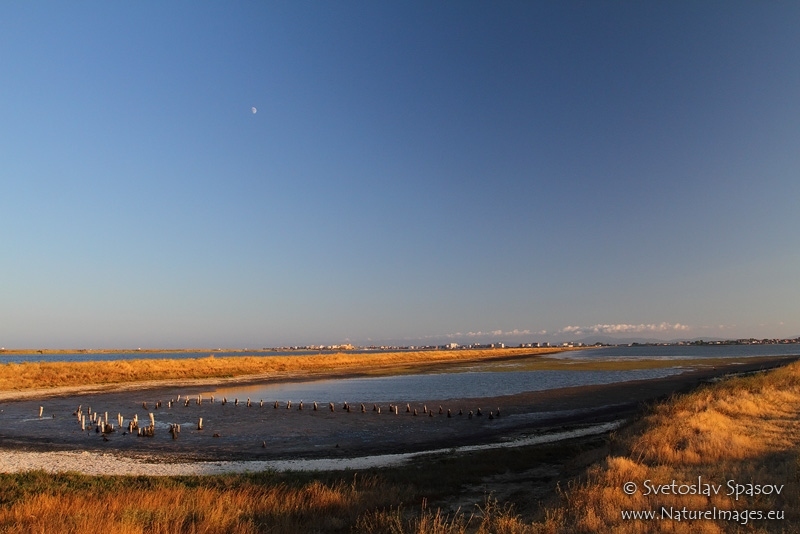
 Pomorie Lake
Latitude: 42.585349
Longitude: 27.617080
Description:
Pomorie lake is a hyper-saline lake of natural origin – a sea lagoon, with a part of its territory turned into saltpans. It is separated from the sea by a sand strip and its only connection with the sea water is a canal with a sluice. The Aheloi River mouth situated north of the lake is also included in the area because of its regular use by waterbirds. The lake is located at about 25 km north of Burgas, immediately next to the road to Varna and the northern part of the town of Pomorie. The main part of Pomorie lake is open water without water-fringe vegetation. The saltpans represent a number of hyper-saline basins with average water salinity about 50 %о. The basins are separated by wooden and embankment dykes, at places sparsely overgrown with Salicornia europaea. Some of the surrounding plots are covered by halophyte grass vegetation, mainly of Puccinellia convoluta, Salicornia europaea, etc. The shallows are fringed with hygrophytes, dominated by Typha angustifolia and Phragmites australis. Small marshes, entirely covered by hygrophyte vegetation are located to the west of the lake and in its southern part. (Bondev 1991; Yankov 1993). The Aheloi River mouth is overgrown with riverine forest and water fringe vegetation.
Birds:
Pomorie Lake is a part of Burgas lake complex, which is one of the three most significant wetland complexes for congregations of waterfowl along the Bulgarian Black Sea coast. The area of Pomorie Lake and its adjacent territories support 204 bird species, 59 of which are listed in the Red Data Book for Bulgaria (1985). Of the birds occurring there 91 species are of European conservation concern (SPEC) (BirdLife International, 2004), 7 of them being listed in category SPEC 1 as globally threatened, 21 in SPEC 2 and 63 in SPEC 3 as species threatened in Europe. The area provides suitable habitats for 72 species, included in Annex 2 of the Biodiversity Act, which need special conservation measures, of which 64 are listed also in Annex I of the Birds Directive. The lake is one of the most important sites in the country for breeding Avocet Recurvirostra avocetta, Black-winged Stilt Himantopus himantopus, Sandwich Tern Sterna sandvicensis, Little Tern Sterna albifrons, Common Tern Sterna hirundo and Kentish Plover Charadrius alexandrinus. It is situated on the Via Pontica migration route and thus particularly important as a migration stopover for considerable numbers of waders, divers, grebes, etc., most of which are included in the Annex of the Bonn Convention. During the winter the wetland regularly supports 1% of the Black Sea population of Mute Swan Cygnus olor. Five globally threatened species occur in the area of Pomorie Lake on migration and in winter –Pygmy Cormorant Phalacrocorax pygmeus, Dalmatian Pelican Pelecanus crisрus, Ferruginous Duck Aythya nyroca, White-headed Duck Oxyura leucocephala and Corncrake Crex crex.


_150x100.jpg)


